Your clients expect their payroll platform to connect to everything. Health benefits. Time tracking. And increasingly, retirement plans. The question is no longer whether to offer retirement connectivity. It is how.
For large enterprise payroll providers, building proprietary retirement infrastructure made sense. For mid-market and regional payroll providers, it does not. The timeline, cost, and compliance complexity make it impractical. But there is a path that delivers the same outcome for your clients without the build.
This guide breaks down what payroll-to-retirement connectivity actually involves, why it matters more than ever under SECURE 2.0, and how mid-market payroll providers are adding it without a single line of custom code.
What Your Clients Are Actually Asking For
When a plan sponsor asks "does your payroll platform work with our 401(k) provider?" they are not asking you to build a retirement product. They are asking whether their payroll data will flow cleanly to their recordkeeper every pay cycle without manual intervention.
That is a connectivity problem. And connectivity problems have pre-built solutions.
The question comes up at multiple points in the sales and retention cycle. TPAs ask it when evaluating payroll platforms on behalf of plan sponsors. Benefits brokers ask it when advising employers on plan setup. HR teams ask it when they are tired of manually exporting files after every payroll run. And plan sponsors switching payroll providers ask it before they commit.
Increasingly, the answer to that question determines whether a deal closes or a client stays. Payroll providers who cannot offer retirement connectivity are losing ground to platforms that can.
The Retirement Data Flow Problem
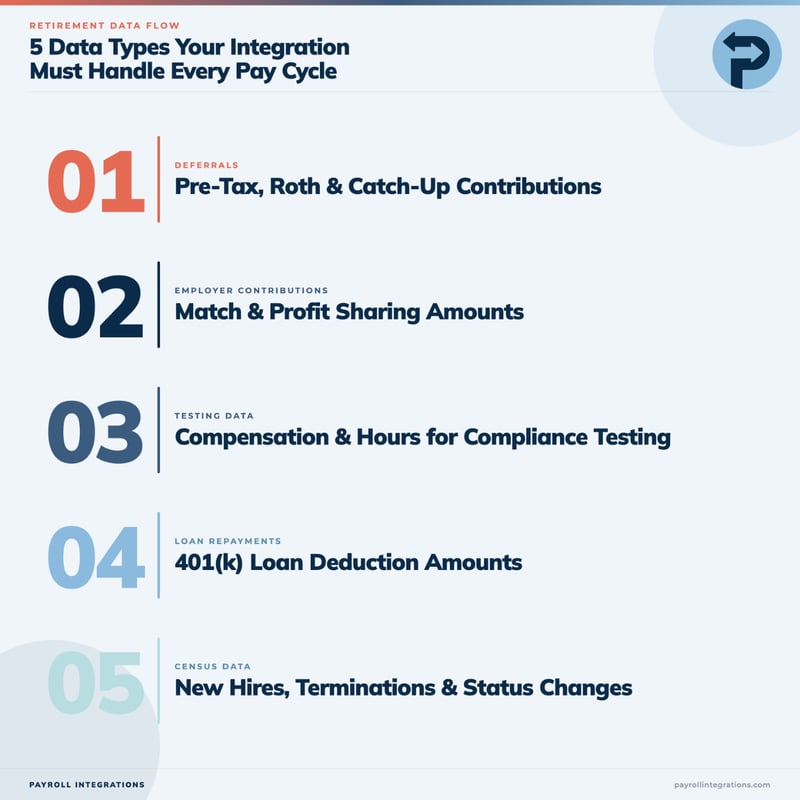
Every 401(k) plan requires payroll data to flow from the employer's payroll system to the recordkeeper each pay period. That data includes:
- Employee deferral amounts (pre-tax, Roth, catch-up)
- Employer match and profit sharing contributions
- Compensation and hours for nondiscrimination testing
- Loan repayment amounts
- Employee census data (new hires, terminations, status changes)
Without a direct integration, this data is exported from payroll, reformatted, and manually uploaded to the recordkeeper by someone. That someone is usually the TPA, the plan sponsor's HR team, or both. It is slow, error-prone, and increasingly unacceptable to clients who expect automated data flow.
The administrative burden is one reason approximately two thirds of small businesses do not offer retirement savings plans at all, according to Fidelity research. The complexity and manual overhead of maintaining plan data is a real barrier. Payroll providers who remove that barrier become part of the solution.
The stakes are higher than convenience. Manual processes introduce contribution errors, missed pay periods, and compliance exposure. With SECURE 2.0 provisions now in effect, including super catch-up contributions and Roth catch-up routing requirements tied to age and income thresholds, getting the data right is a compliance issue, not just an operational one. The payroll system is where those classifications have to be set correctly before anything reaches the recordkeeper.
|
Manual retirement data processes introduce contribution errors, missed pay periods, and compliance exposure. Connectivity is the fix — and the payroll platform is where it starts. |
What Pre-Built Retirement Connectivity Looks Like
Pre-built API integrations connect your payroll platform to recordkeepers directly. Payroll data flows automatically on each payroll run with no manual export, no file upload, and no intervention required.
For mid-market payroll providers, this means:
- Clients who use supported recordkeepers get seamless data flow out of the box
- You are not building or maintaining the integration infrastructure
- You are not absorbing compliance risk for retirement data errors
- You are differentiated in a market where most mid-market platforms still rely on manual processes
The integration handles contribution code translation, file formatting, and recordkeeper-specific requirements. Every recordkeeper has its own file specs, data field requirements, and formatting rules. A pre-built integration layer manages all of that behind the scenes.
When regulatory requirements change, such as new SECURE 2.0 contribution categories or updated IRS thresholds, the integration provider manages the updates. Your clients do not experience a disruption. You do not need to retool anything. The infrastructure is already built, and it stays current.
The connectivity is also bidirectional. Deferral changes and enrollment elections from the recordkeeper route back to payroll automatically, so the data stays in sync in both directions without anyone manually reconciling records between systems.
What Implementation Actually Involves
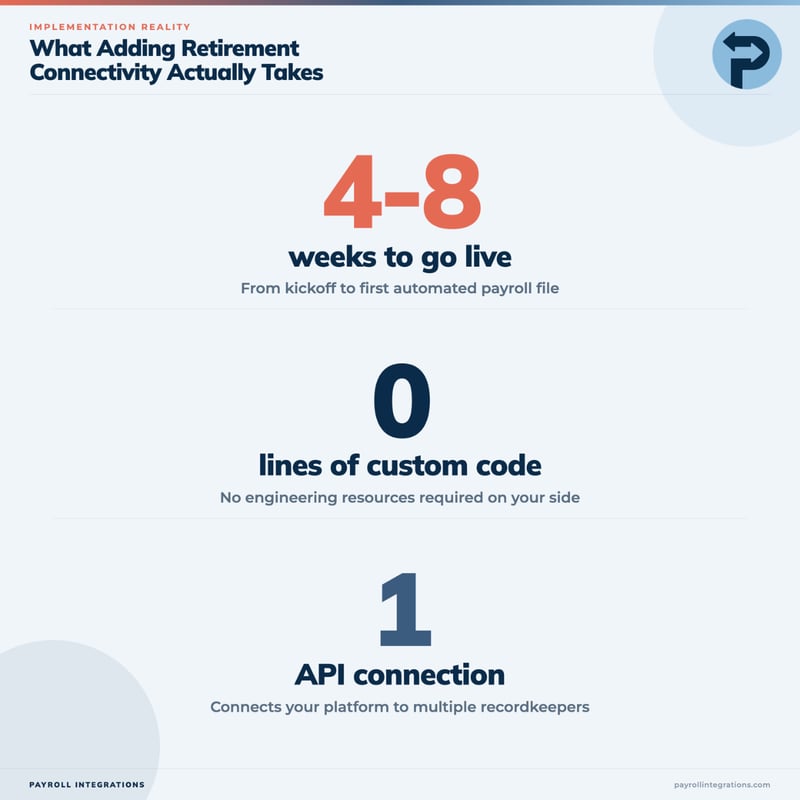
This is where most payroll providers expect complexity. In practice, adding retirement connectivity through a pre-built integration model is far simpler than an internal build:
- Timeline: Most implementations go live in 4 to 8 weeks
- Technical lift: Minimal. Pre-built connectors are designed to work with existing API structures. No custom development required on your side.
- Compliance: Contribution code mapping, data translation, and file formatting requirements are handled by the integration layer
- Ongoing maintenance: The integration provider manages recordkeeper spec changes and regulatory updates
The comparison to an internal build is significant. A proprietary integration with a single recordkeeper can take 12 to 18 months and require dedicated engineering resources. A pre-built model connects you to multiple recordkeepers simultaneously, with implementation measured in weeks, not years.
The implementation process typically involves a kickoff to map your existing payroll codes to retirement contribution types, a testing phase where data flows are validated against real pay cycles, and a go-live once the data is confirmed accurate. The plan sponsor confirms the totals match before the integration goes live. From that point, the process is automated.
For payroll providers with clients who are already asking about retirement connectivity, that 4 to 8 week timeline means the gap between "we are looking into it" and "it is ready for your clients" is short.
The Business Case for Mid-Market Payroll Providers
Retirement connectivity is increasingly a table-stakes expectation for payroll platform clients. Plan sponsors evaluating payroll providers ask about it. TPAs ask about it when recommending platforms to their clients. Benefits brokers ask about it when advising employers on plan design.
The retention angle matters too. More than 11,200 Americans turn 65 every day through 2027, according to the Retirement Income Institute. Employees at every level of the workforce are prioritizing retirement savings. Employers who can offer seamless 401(k) participation through their payroll platform have a meaningful advantage in recruiting and retaining talent. Employers who cannot are asking their HR teams to fill the gap manually.
Payroll providers who can say yes to the retirement connectivity question close more deals and retain more clients than those who cannot. The platforms that offer it did not all build it themselves. They connected to infrastructure that was already built.
For mid-market providers looking to compete with larger platforms on benefits connectivity, the gap is smaller than it looks. The infrastructure exists. The question is whether you are using it.
|
Payroll Integrations connects payroll platforms to leading 401(k) recordkeepers through pre-built API integrations. Learn more about our payroll partner model. |
Frequently Asked Questions
How long does it take to add retirement connectivity to a payroll platform?
Most implementations go live in 4 to 8 weeks from kickoff. The process includes payroll code mapping, a testing phase with real payroll data, and plan sponsor confirmation before the integration goes live. There is no custom development required on the payroll provider's side, which keeps the timeline short compared to a proprietary build.
Does adding retirement connectivity require engineering resources from our team?
No. Pre-built retirement integrations are designed to work with existing payroll API structures. The integration provider handles contribution code mapping, file formatting, and recordkeeper-specific requirements. Your team's involvement is primarily on the configuration and testing side, not development.
Which recordkeepers can mid-market payroll providers connect to?
Pre-built integration platforms connect to a range of leading recordkeepers across the 401(k) market. The specific list depends on the integration provider, but the goal of a pre-built model is broad recordkeeper coverage so that plan sponsors using different recordkeepers do not each require a custom build. When evaluating an integration partner, ask for the full recordkeeper list, not just the names on the marketing page.
How does SECURE 2.0 affect payroll-to-recordkeeper data requirements?
SECURE 2.0 introduced new contribution types that require specific handling at the payroll level. Super catch-up contributions for employees aged 60 to 63 require age-based routing. Roth catch-up requirements apply to employees earning above $145,000 and require income-based classification. These are payroll data classification problems, not plan design problems. The payroll system has to identify and route these contributions correctly before the data reaches the recordkeeper. A pre-built integration that is current with SECURE 2.0 handles this automatically.
What happens when a plan sponsor switches payroll providers mid-year?
This is one of the most operationally complex scenarios in the 401(k) data flow. When a plan sponsor changes payroll providers, the retirement integration has to be rebuilt or migrated to the new platform, and historical payroll data may need to be reconciled for nondiscrimination testing purposes. Payroll providers who offer pre-built connectivity through an integration partner can often migrate existing clients more cleanly than those who built proprietary integrations, because the integration layer sits between the payroll platform and the recordkeeper rather than being embedded in either system.
Ready to Add Retirement Connectivity to Your Platform?
If you are a payroll provider evaluating how to add retirement connectivity, we can show you what it looks like in practice, what implementation involves for your platform specifically, and which recordkeepers your clients are already asking about.
Schedule a conversation with our team to see how other payroll providers have added retirement connectivity without a single line of custom code.
Related Reading
SECURE 2.0 and Payroll Data: What TPAs Need to Know
.png)